日本語
← Back to works
Tenran Kagura | KOHIKO
Click to enlarge
Multiple edition / FINE ART PRINT

Tenran Kagura天覧神楽

Gift ideaFor milestones on the road of life: a journey, a move to a new place, or a new car
For those stepping onto a new path: starting school, a new job, or going independent
For Japanese spaces that welcome guests: restaurants, ryokan inns and ryotei
Year
2026
Subject
Sarutahiko Okami
Work size
A3 / 420 × 297 mm
Medium
Digital painting (created on iPad)
Type
Multiple edition (framed giclée print)
Framed size
H 492 × W 369 mm / gold frame, UV-cut acrylic
Shop pageA3 framed giclée print
作品に込めた想い

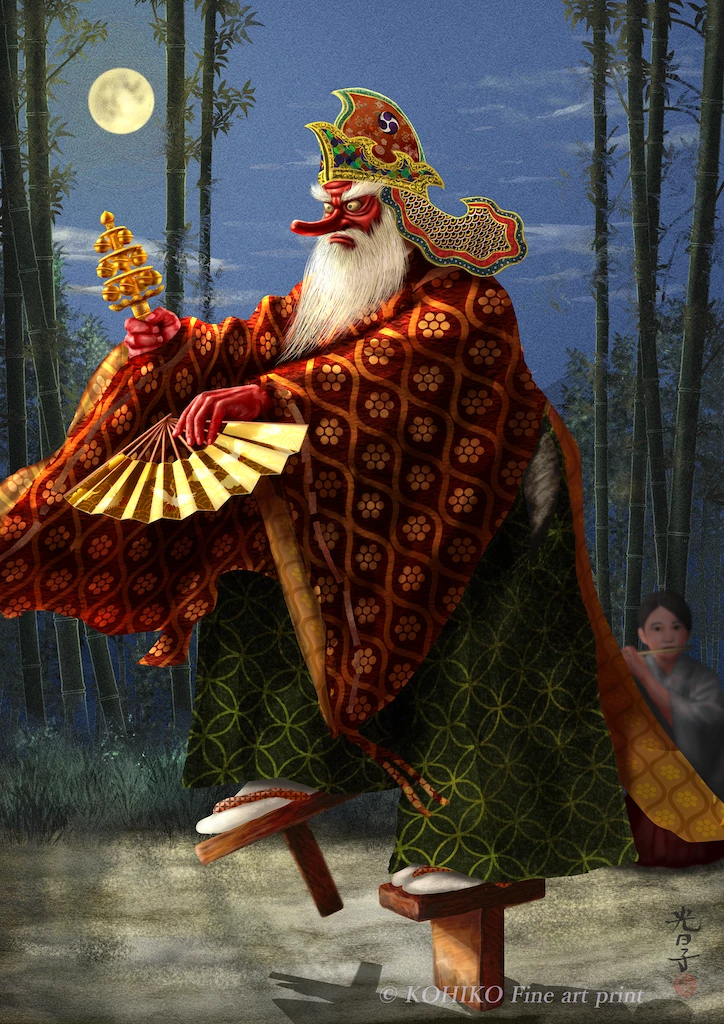
Sarutahiko Okami is said to have guided Ninigi-no-Mikoto, grandson of the Sun Goddess, from the High Plain of Heaven down to Takachiho. Known as the deity of "michi-hiraki", who opens the way ahead and leads people in a good direction, he is loved throughout Japan. In this work, I painted him dancing kagura in a moonlit bamboo grove.

Meeting Sarutahiko

I first became aware of Sarutahiko in 2023, when my wife and I visited Ise Grand Shrine to celebrate our 30th wedding anniversary. Along the way we stopped at Sarutahiko Shrine; I remember thinking, "I've heard that name before," as I put my hands together in prayer.

Some time later, this summer, I learned there was a shrine on Mt. Tengu in Otaru and went to visit. At the summit, the Tengu Hall displays replicas of Sarutahiko masks with tengu faces, and Sarutahiko Okami is also enshrined at Tenguyama Shrine on the summit. It was on that mountain that the wish to paint Sarutahiko was born.

A kagura dance in the mountains, midway through the journey

I drew many rough sketches, wondering how to depict him. A fierce, rather frightening Sarutahiko is a familiar image. Could I paint a different Sarutahiko? I imagined his journey as a guide. On such a long road he must have grown tired and stopped to rest, and it was hardly a journey with inns along the way. What if, taking a breath in the mountains, Sarutahiko danced kagura himself? I kept his bold face, and, with all respect, asked him to dance.

The pose, from Matsumae Kagura

While I was looking for references for the dance, on October 25 I had the chance to attend the ceremony marking the 150th anniversary of Ryugu Shrine in Otaru, where I saw Matsumae Kagura performed. Watching my video of the dance again and again, I found a single moment when the dancer raised his face and leaned forward, and used it as the reference for the pose in this work.

Sarutahiko is also said to have married Ame-no-Uzume-no-Mikoto. In the background I added a shrine maiden playing the flute, but the main figure is, of course, Sarutahiko.

In a moonlit bamboo grove

I wanted an evocative scene: dancing at night beneath moonlight spilling through the bamboo. I hope you will take a close look at this guiding deity, dancing alone on a quiet night.

KOHIKO, painter
鳥兜

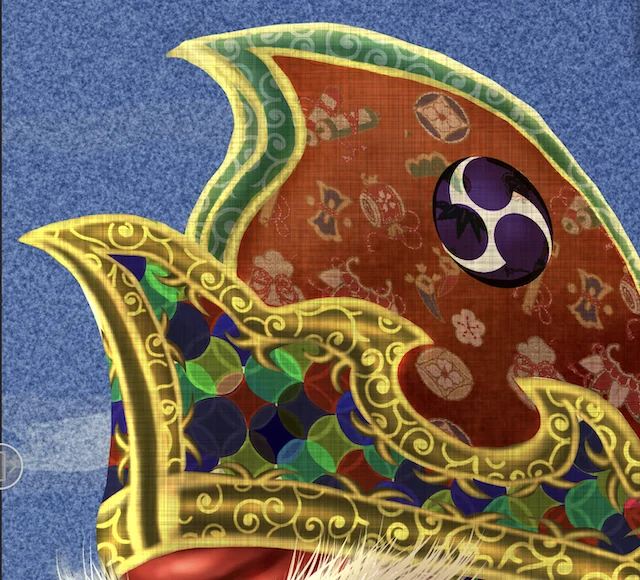
The bird-headed headdress worn in Sarutahiko dances throughout Japan. It is said to be named after the torikabuto (aconite) flower, which it resembles. I followed its traditional shape, but wanted to design the patterns in my own way, choosing an auspicious motif for each part.

Tenran Kagura, head of the torikabuto crown

Head of the crown

In the five sacred colors of the shrine

Where the bird's eye would be, I placed a mitsudomoe (triple comma), a motif also seen in old ornaments. The red head carries takara-zukushi (treasures), and the green beak karakusa (arabesque scrolls).

The crown below has golden karakusa, with shippo (seven treasures) in the green areas inside. The whole crown is colored in the five colors used at Shinto shrines.

Tenran Kagura, fins of the torikabuto crown

Fins of the crown

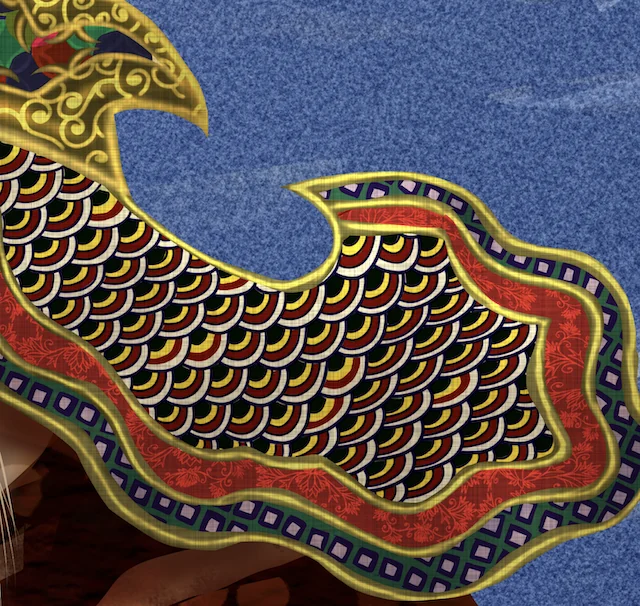
Three patterns layered in the fins

The outermost band of the fins is kanoko (fawn-spot dapple). On the red fabric inside it, I used an old lotus-leaf pattern I created for Benzaiten's robe in The Treasure Ship of the Seven Lucky Gods.

The innermost part is seigaiha (blue ocean waves) turned upside down to look like scales, painted in the five colors. I think it turned out to be quite a pattern.

神楽鈴と扇
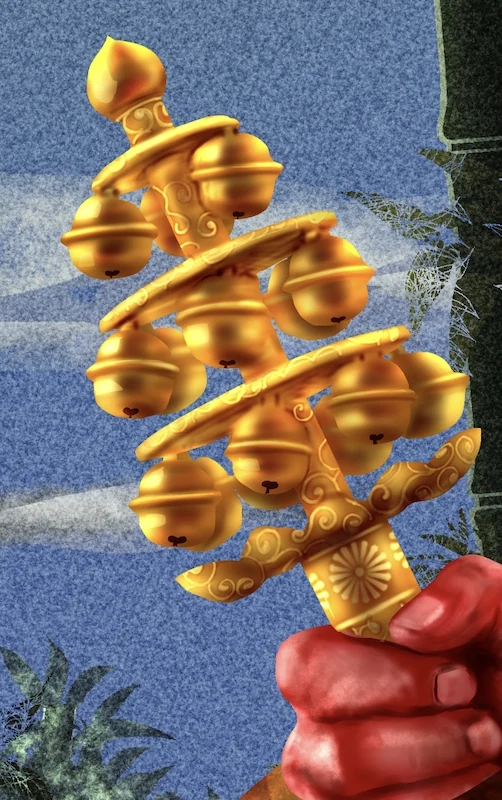
Kagura bells
Kagura bells
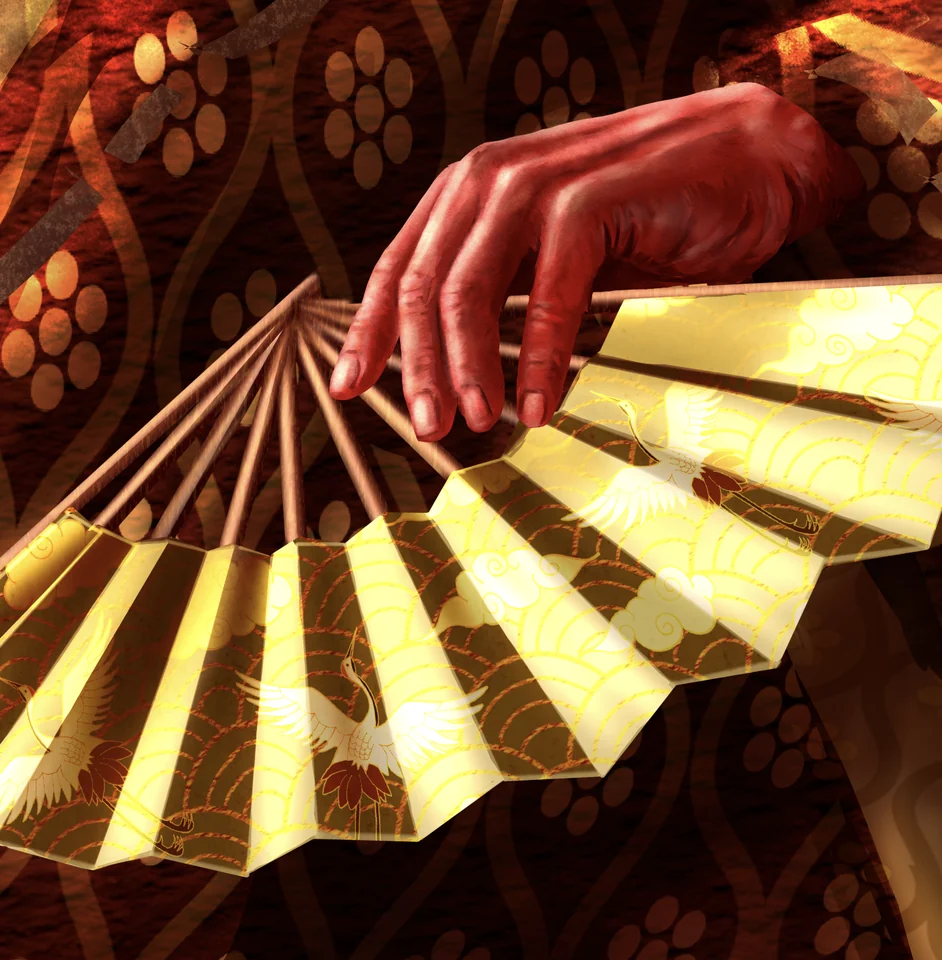
Fan with cranes and clouds

Chrysanthemum-crest bells, crane-and-cloud fan

The bells he holds are modeled on those used in kagura. In keeping with the title "Tenran Kagura", I placed the Imperial chrysanthemum crest on the handle.

For the fan, I used the crane-and-cloud pattern from Fukurokuju in The Treasure Ship of the Seven Lucky Gods.

装束
Tatewaku and shichiyo-mon on the costume
Tatewaku and shichiyo-mon
Shippo hakama and tall geta

Rising good fortune, and a pattern of the cosmos

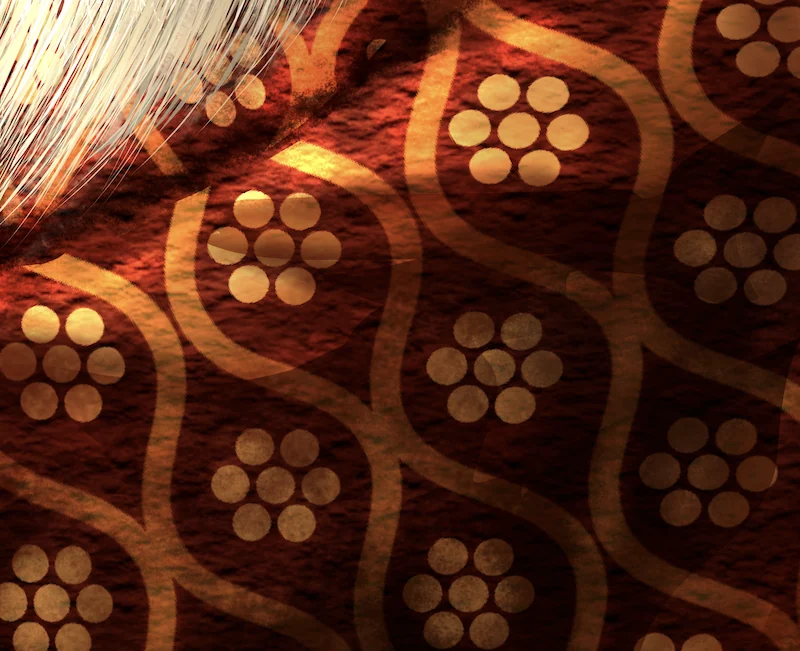
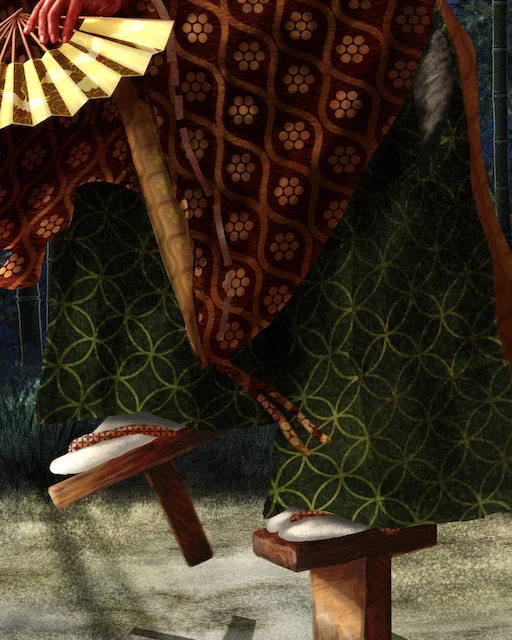
The robe bears tatewaku, an auspicious pattern of lines rising and swelling from bottom to top. In each swell I placed the shichiyo-mon, a crest said to represent the cosmos. The base color is orange, something of a signature for Sarutahiko.

The hakama carries shippo, and so do the thongs of the tall geta.

月とサイマティクス
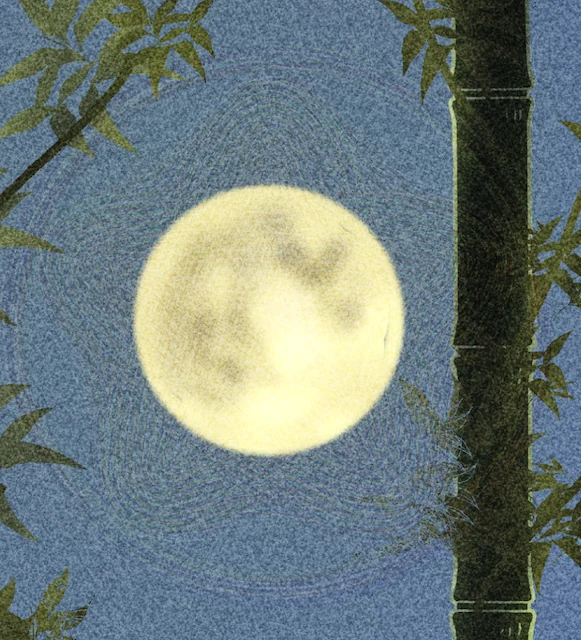
Moon between the bamboo
The moon between the bamboo
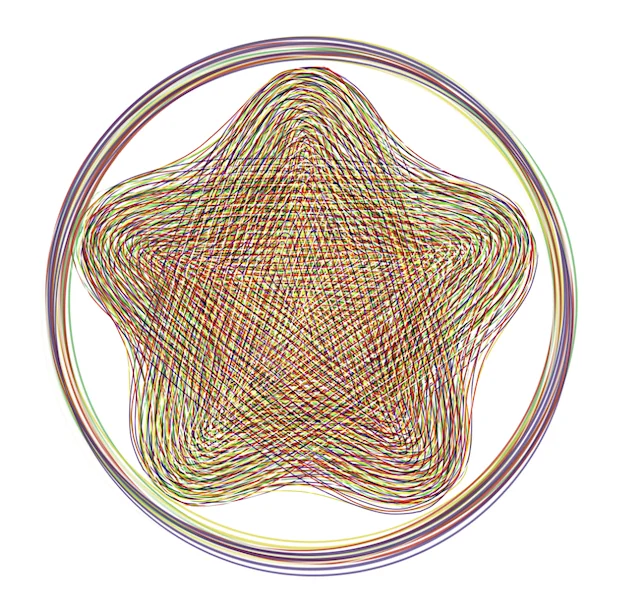
Cymatics pattern of the word tanoshi
The pattern of "tanoshi"

"Tanoshi", layered in the moonlight

Cymatics makes sound visible as form. Words, too, can be given form, and I bring those forms into many of my works.

In this work, the cymatics pattern of the word "tanoshi" (joyful) is faintly layered around the moonlight. The form that appeared from its three sounds, "ta", "no" and "shi", was a pentagon. It may be hard to see, but look closely at the ripples around the moon.

This pentagon is drawn in the five sacred colors of Shinto shrines: green, yellow, red, white and purple. From each of the five corners I drew a triangle, and joined them all together to form the pentagon. When every color had been layered, they blended, and the whole pattern mysteriously rose up in orange, the very color of Sarutahiko's robe. Unexpectedly, the pattern and his costume were connected.

What is cymatics? →

大きさと飾るイメージ
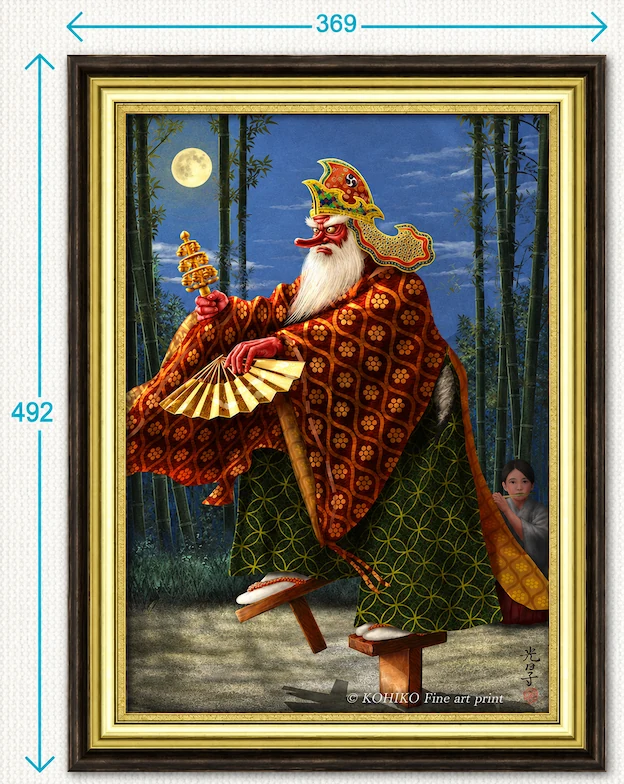
Tenran Kagura, framed (outer size 492 × 369 mm)

Framed (outer size H 492 × W 369 mm)

Frame outer size
H 492 × W 369 mm (A3, portrait)
Visible image
H 410 × W 287 mm
Work size
H 420 × W 297 mm (A3)
Weight
approx. 1 kg
Frame
Drawing frame MRN-D3042-B gold, UV-cut acrylic
Printing
Giclée print (fade-resistant pigment inks)
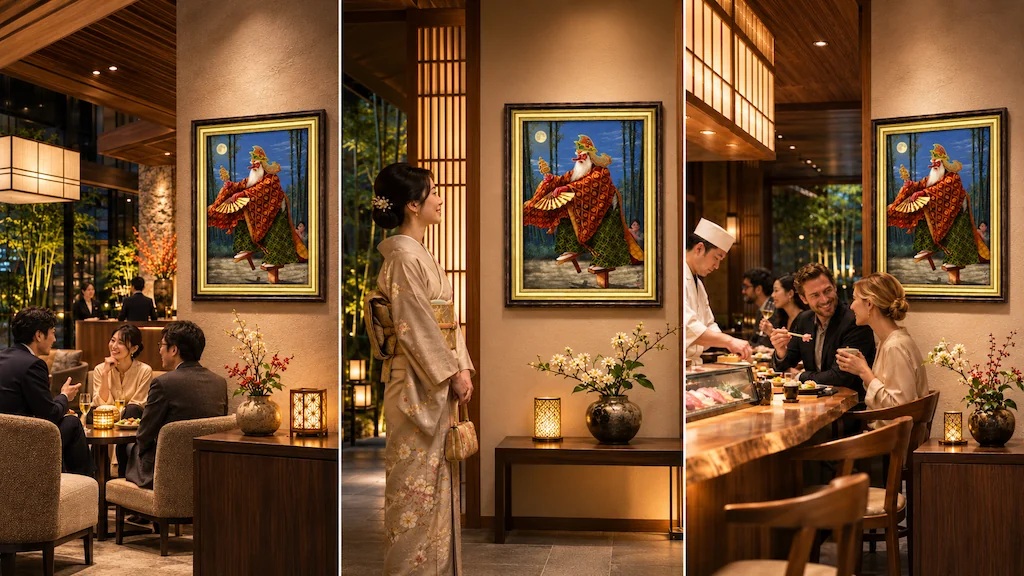
Tenran Kagura display examples: hotel lounge, entrance of a Japanese restaurant, Japanese dining counter

Display examples: a hotel lounge, the entrance of a Japanese restaurant, a Japanese dining counter

* These are display images. The "© KOHIKO Fine art print" text on the work images is to prevent unauthorized use and does not appear on the delivered work.

ご購入はオンラインショップから
×